

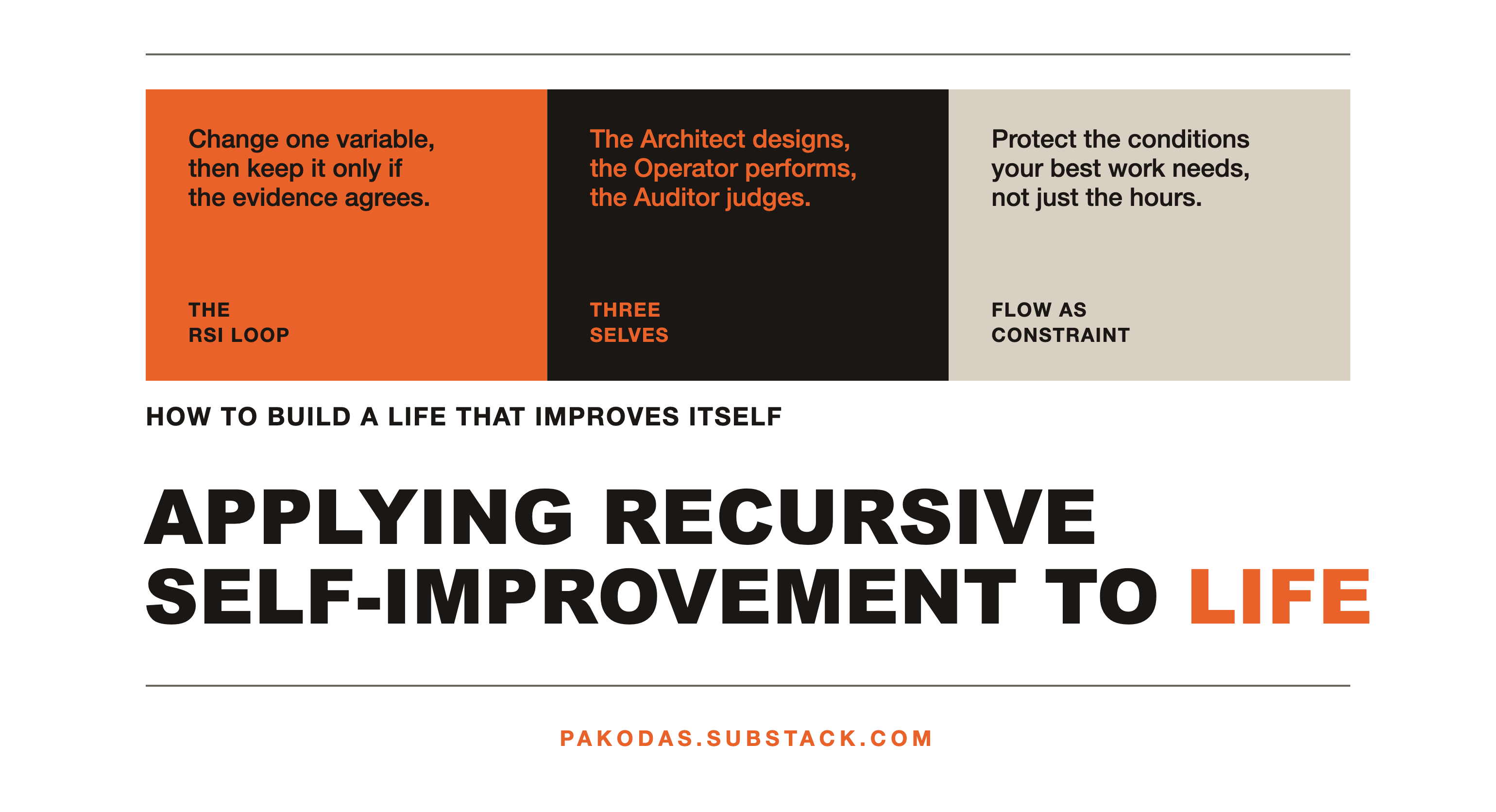
Self-improvement systems collapse into a pile of obligations.
It always starts reasonably. A problem shows up, so you add a habit. The habit needs watching, so you add a tracker. The tracker wants a morning review, then a weekly one, then a dashboard and soon a backlog of all the ways you still ought to improve. Give it a few months and the maintenance costs more than the original problem ever did.
Recursive self-improvement (RSI) is a way out of that trap because it treats improvement as something other than doing the same thing more often. Repetition is just search. A system actually improves when it changes something, checks that change against what came before and keeps it only when the evidence says it earned its place.
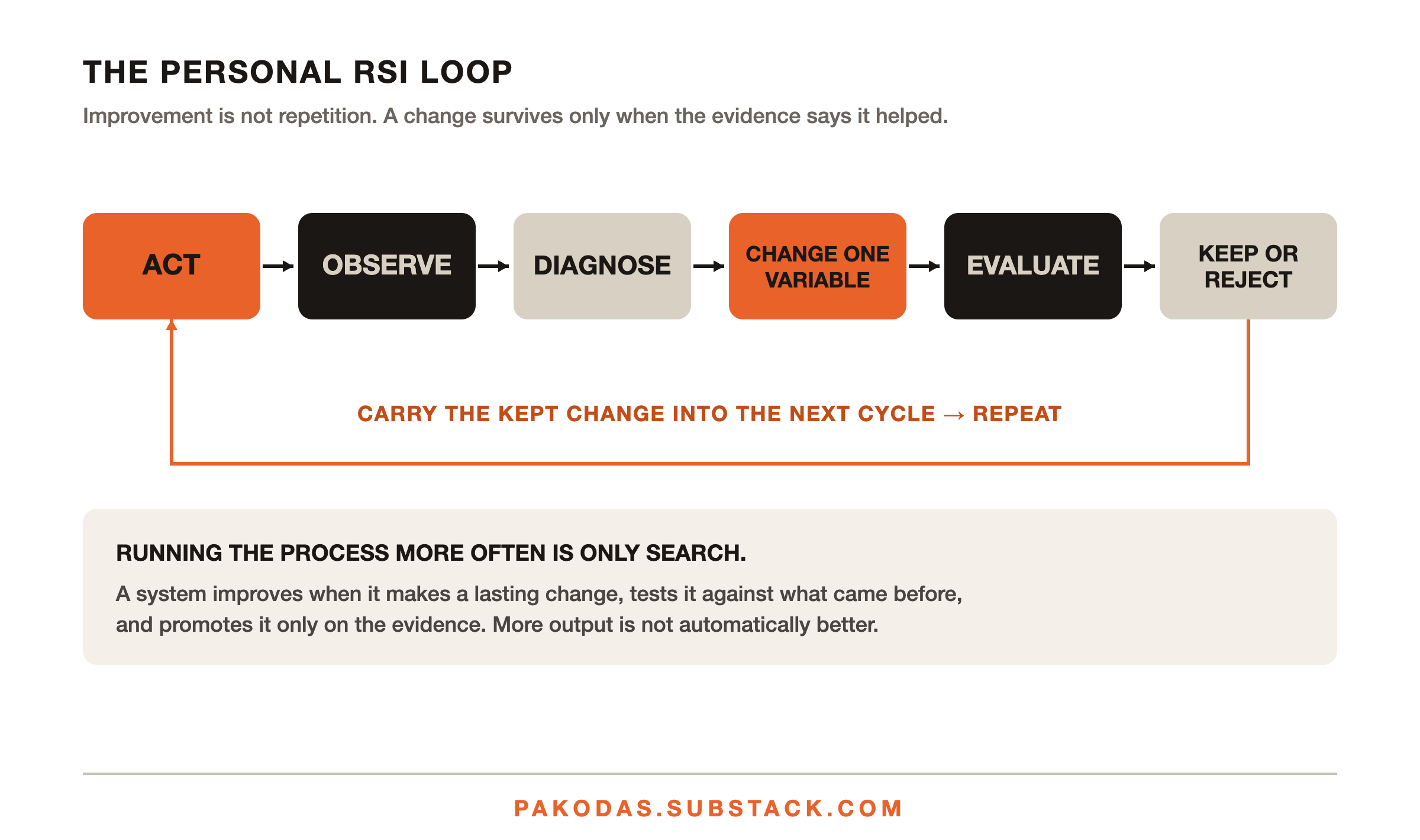
A life is not software. More output is not automatically better. A routine that pushes your task count up while quietly draining your curiosity, your health, or the people around you has failed. So the target isn’t maximum productivity. It’s a life that keeps getting better at the work that matters to you without burning the attention and energy that good work runs on.
Borrow the algorithm, not the lifestyle
The people who experiment hardest on themselves share one habit worth stealing. They treat daily behavior as a system you can watch, test, and adjust, instead of a verdict on your character.
Put plainly, your morning self can protect your evening self by deciding things before impulse gets a vote. That’s personal RSI in its most intuitive form. The recurring failure is your evidence. A rule, or a tweak to your environment, is the thing you get to revise. The steadier self proposes the change and the protocol carries it into the next tempting moment so you don’t have to relitigate it every time.
You don’t need anyone’s diet, supplement stack, or medical routine to run this. Take the principle and leave the rest. The point was never extreme optimization. Set your defaults so the better move is also the easier one.
Morning improves afternoon improves evening improves morning. That is the RSI on a day to day basis.
Give your different selves different jobs
Most of the friction in self-improvement comes from three versions of you trying to work at the same time. Pull them apart and things get calmer.
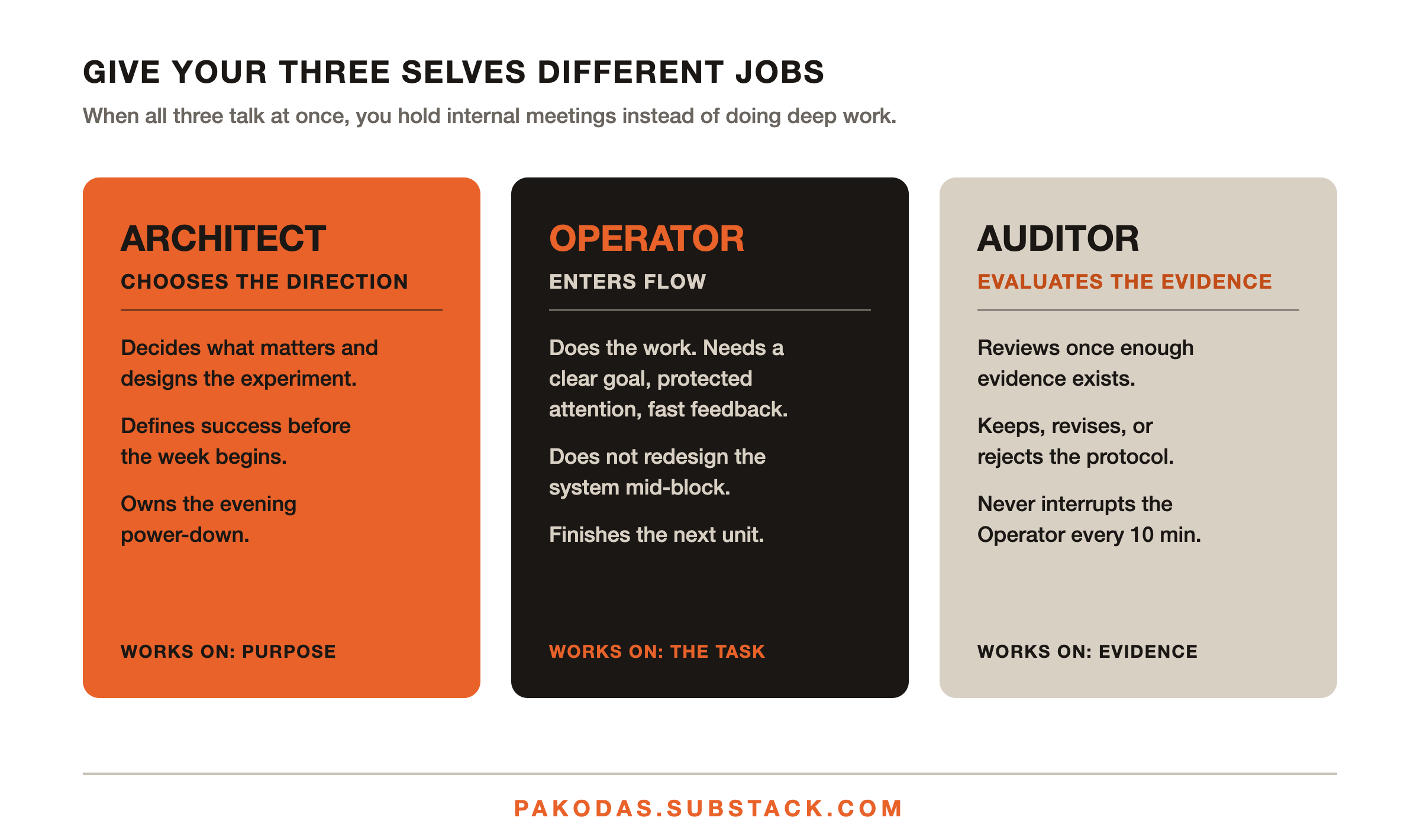
The Architect chooses the direction
The Architect designs the experiment and decides what success looks like before the week starts. Its purpose doesn’t need to be a manifesto about saving humanity; it only needs to be sturdy enough to help you say no. Suppose your aim is to make AI cheaper and easier to understand. Ten shiny ideas might turn up in a single week but only 1 out of 10 ideas serve our goal. That’s the whole job of purpose. It kills shiny-object syndrome not through willpower but by making the “no” obvious.
The Operator enters flow
The Operator does the work and it wants only four things: a clear goal, protected attention, quick feedback, and a task pitched just past what it can already do. What it doesn’t want is to redesign the system mid-session, reopen the annual plan, reorganize the task list, or wonder whether some other project would be more fun. Its job is narrow on purpose. Finish the next real piece of work.
The Auditor evaluates the evidence
The Auditor shows up later, once there’s enough evidence to be worth reading. It lines the new protocol up against the old one and decides whether to keep it, tweak it, or bin it. The one thing it can’t do is lean over the Operator’s shoulder every ten minutes, because watching yourself work is one of the fastest ways to break the state you’re trying to reach.
Keep the three apart and you protect the work and the judgment at once.
The Architect designs. The Operator performs. The Auditor judges.
Let them all talk at once and you’ve traded deep work for an all-day meeting with yourself.
Turn purpose into one core focus
There sits a gap between a lofty purpose and the next thing you actually do. A goal stack bridges it, stepping down from meaning to specifics until the next action is obvious.
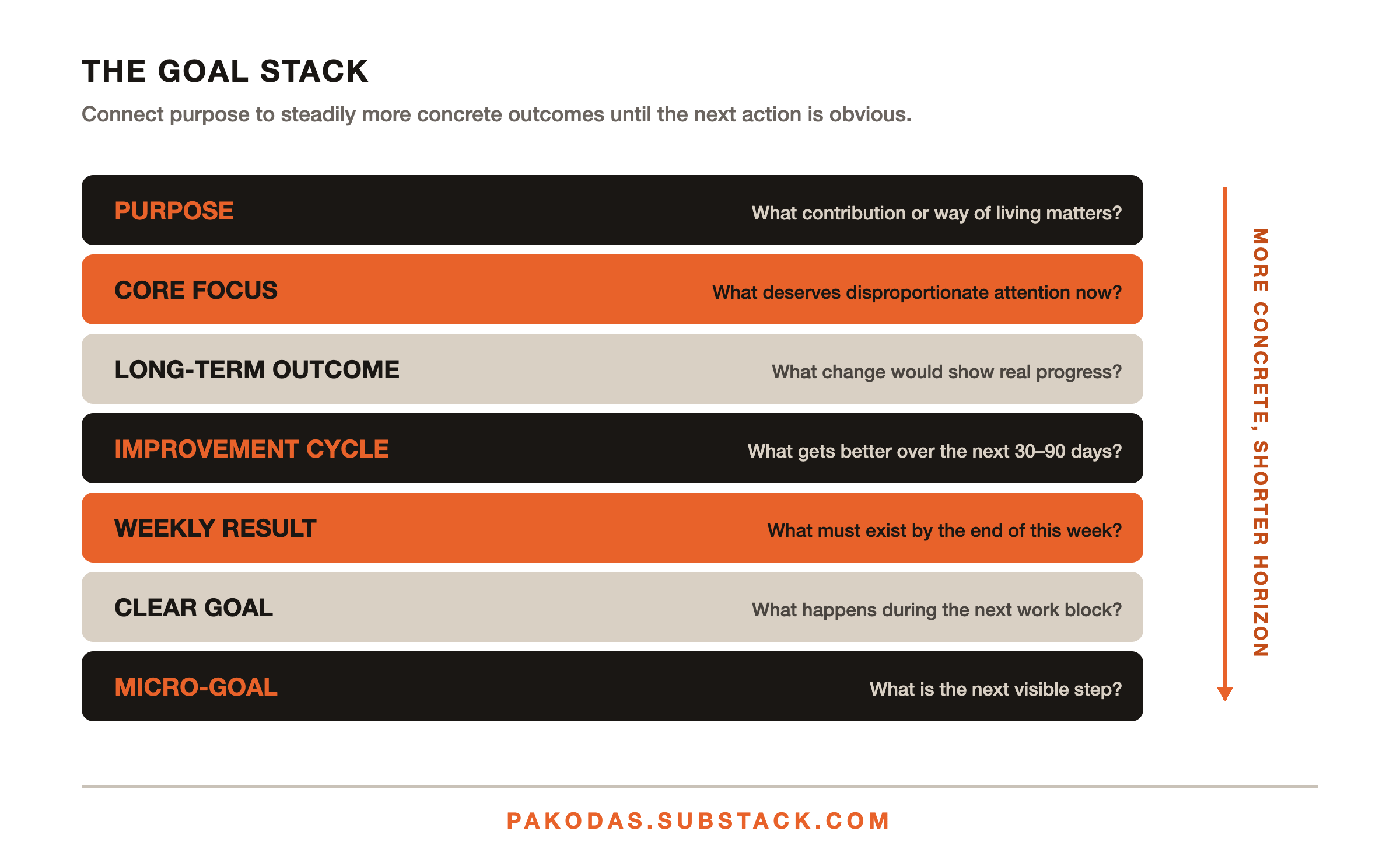
The shorter the horizon, the more concrete the words should get. “Become a better writer” isn’t something you can act on this morning. “Draft the opening and the central argument before lunch” is. Concrete goals earn their keep by shrinking the number of decisions the Operator makes mid-flight, and every micro-goal you finish hands back a small jolt of feedback that keeps you glued to the task.
The evening wind-down belongs to the Architect, not the Operator. Look over the goal stack, cut what no longer fits, and set tomorrow’s first goal tonight. Then the morning opens with work instead of another round of admin.
Put flow before the phone
“Flow before phone” is a fine slogan, but the mechanism behind it is what matters. The first thing you feed your attention sets what it hunts for over the next few hours. Start on a feed and your hard project has to compete with a reward schedule it can’t hope to match. Start on one real problem and your mind has a fair shot at sinking into it.
So a simple morning protocol:
Decide the task the night before.
Keep the phone out of the room.
Open only what the task needs.
Name the result you want from the block.
Begin before you touch messages or feeds.
None of this needs a two-hour sunrise ritual. If your ritual keeps postponing the work, it’s just procrastination in nicer clothes. Prepare at night. Execute in the morning.
How to Be a 30x AI Engineer with a Taste

A different kind of engineer is becoming disproportionately valuable. And almost nobody can precisely explain why.
Train attention progressively
Treat focus like a muscle, because it behaves like one. Nobody expects an untrained runner to be comfortable at hour three, yet we routinely demand hours of unbroken concentration from an attention span that notifications have trained to twitch. Start with a block you can genuinely finish well. If that’s forty minutes, then forty is the number. Stretch it only once the current length feels easy.
And measure the right thing. You’re tracking quality, not endurance theater. A ninety-minute session spent drifting between tabs and rereading the same paragraph isn’t progress. It’s just a long time.
Boredom pulls its weight here too. A little under-stimulation teaches the mind that not every empty second is a problem to solve. A walk without a podcast, a meal without a screen, two minutes in a queue without reaching for your phone: each one chips at the reflex that novelty must arrive right now.
The goal isn’t to become someone who enjoys staring at walls. It’s to stop treating a quiet moment like an emergency.
Recovery is part of the improvement loop
Deep work runs up a debt, and ignoring it doesn’t clear it. It moves the bill to tomorrow. One way to picture this is allostatic load, the wear that piles up as you adapt to stress over and over, and the practical takeaway is to swing deliberately between activation and recovery rather than idling at a medium hum all day.
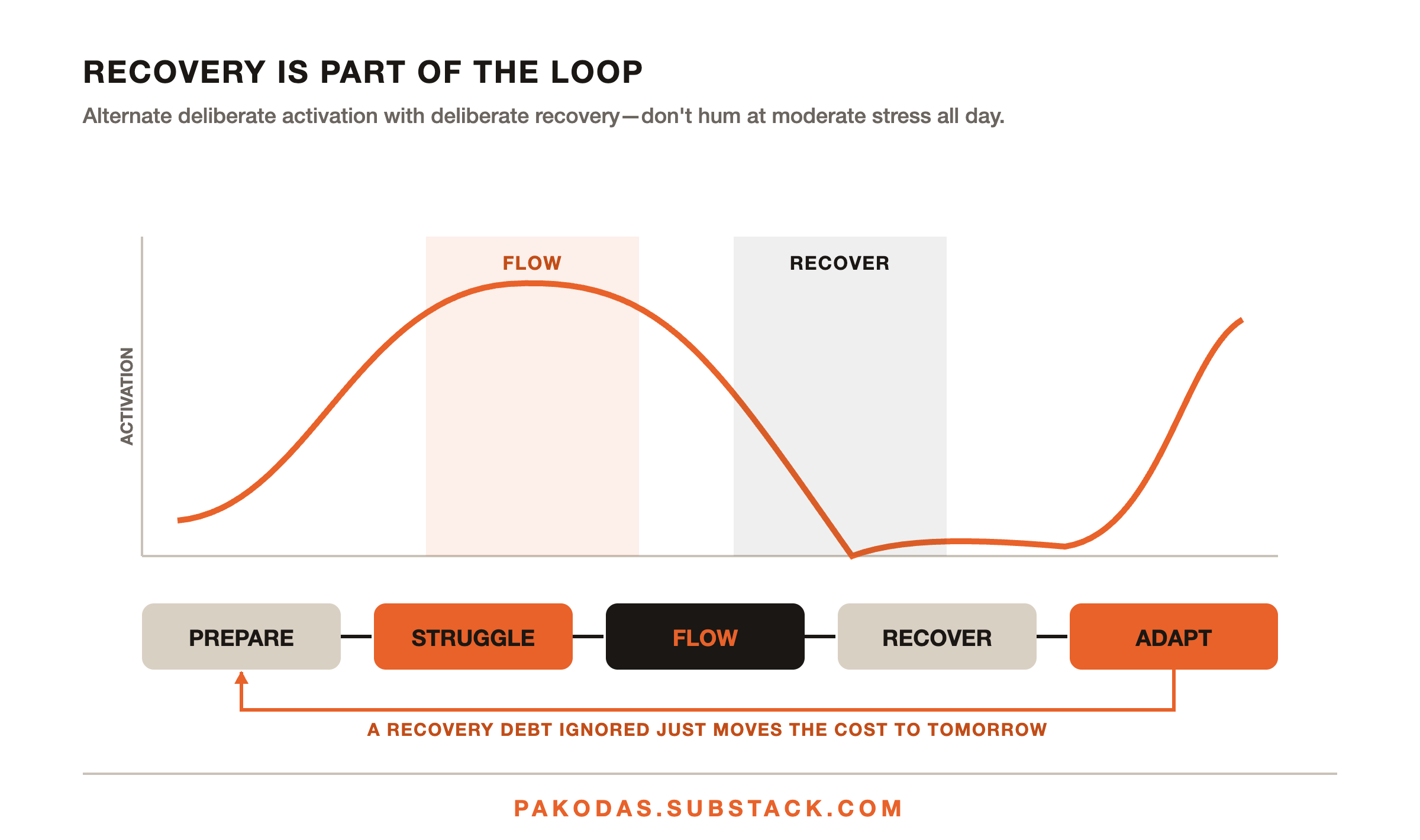
Most people polish the flow block and let recovery be whatever’s left once they’re too fried to continue, which is a bit like tuning a training plan while skipping sleep. And recovery isn’t distraction. Scrolling feels easier than working, but easy input rarely restores anything, while deliberate recovery lowers the load and leaves you readier for the next round. In practice that’s sleep, time outside, easy movement, a quiet hour with people you like, slow breathing, or an afternoon with no plan at all.
The only question that counts is whether it gives back the capacity you mean to spend again.
Run one experiment at a time
The fastest way to learn nothing is to overhaul your sleep, schedule, diet, tools, goals, and habits in the same week. Personal RSI runs on bounded experiments instead. Change one thing that matters, hold the rest steady and whatever moves can be traced to what you changed. Here’s how you can measure after changing a variable:
Start latency: how long before you actually began?
Attention: how much unbroken useful work happened?
Outcome: did the thing that matters move?
Flow: how absorbed did it feel, 0 to 3?
Energy: did you end up, level, or down?
Recovery: were you ready to go again the next day?
Keep those as separate readings, not ingredients for one grand productivity score. Blend them into a single number and you hide the very trade-offs you need to see.
Expect the performance dip
A new protocol usually makes things worse before it makes them better. Take away the phone and you find out how uncomfortable sustained attention has quietly become. Hand off a task and you spend longer writing the instructions than the task would have taken. Automate a workflow and it eats a few sessions before it gives any time back. Build a new skill and you slow down before you speed up. This is the dip: the stretch you pay through before adaptation or leverage pays you back.
The RSI answer to the dip isn’t to grit your teeth forever. It’s to set the terms in advance. How much regression you’ll tolerate, how long the trial runs, and which specific failure ends it early. That one decision saves you from quitting a good change too soon and from clinging to a bad one too long.
Use leverage only after you understand the system
Once a workflow is stable, it’s worth adding leverage. Leverage comes in three flavors, people, systems, and skill, and recurring work tends to move through them in a particular order:
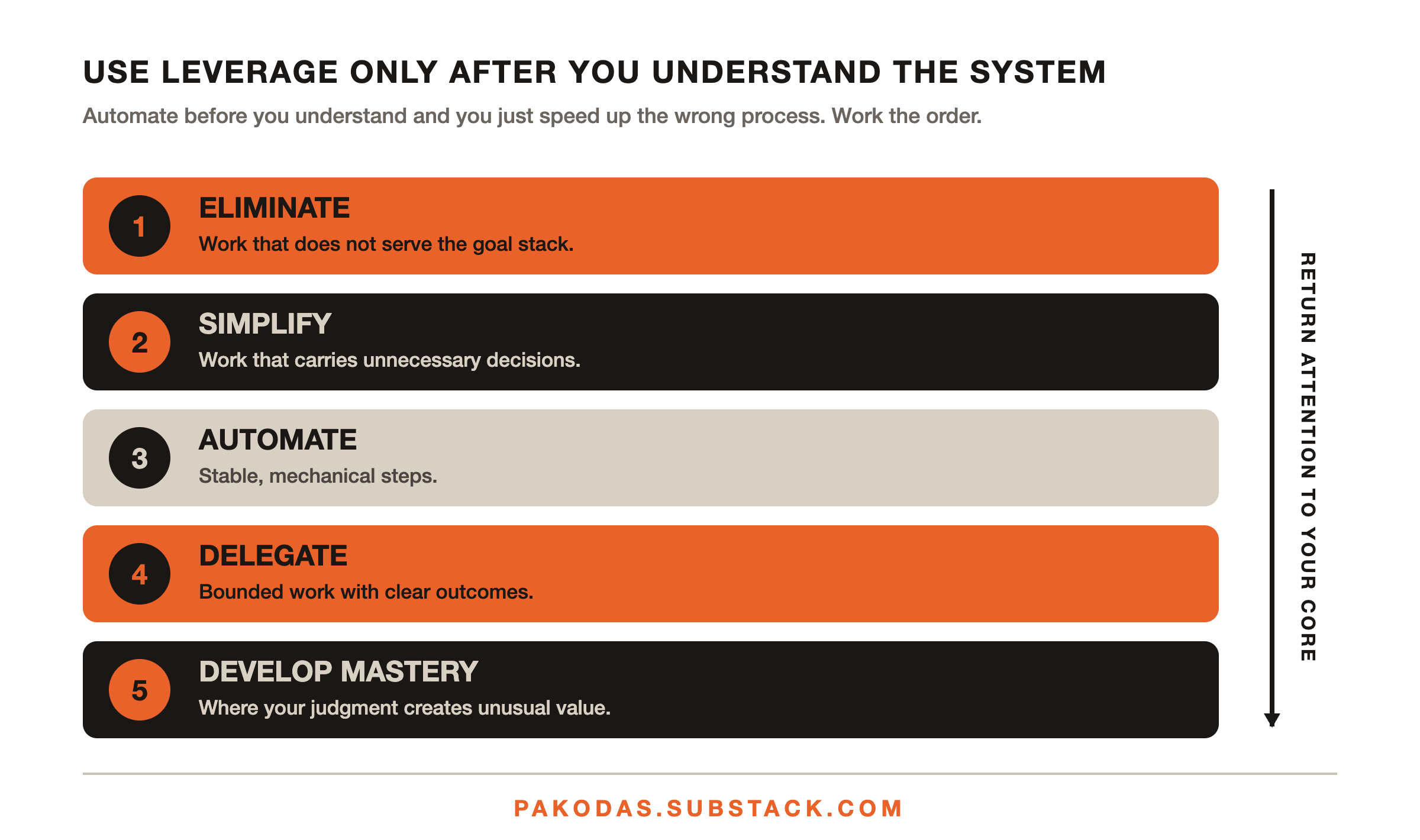
Order matters, because leverage applied too early does real damage. Automate a process you don’t understand and you just speed up the wrong one. Delegate without a clear judge of “good” and you make more coordination than you save. And nothing should be engineered to preserve work that ought to disappear. Done right, leverage hands attention back to the part only you can do instead of stacking more activity.
Nest the loop inside bigger loops
The loop doesn’t only run once a week. The same act, check, keep shape works at every scale you live on, and the scales feed each other.
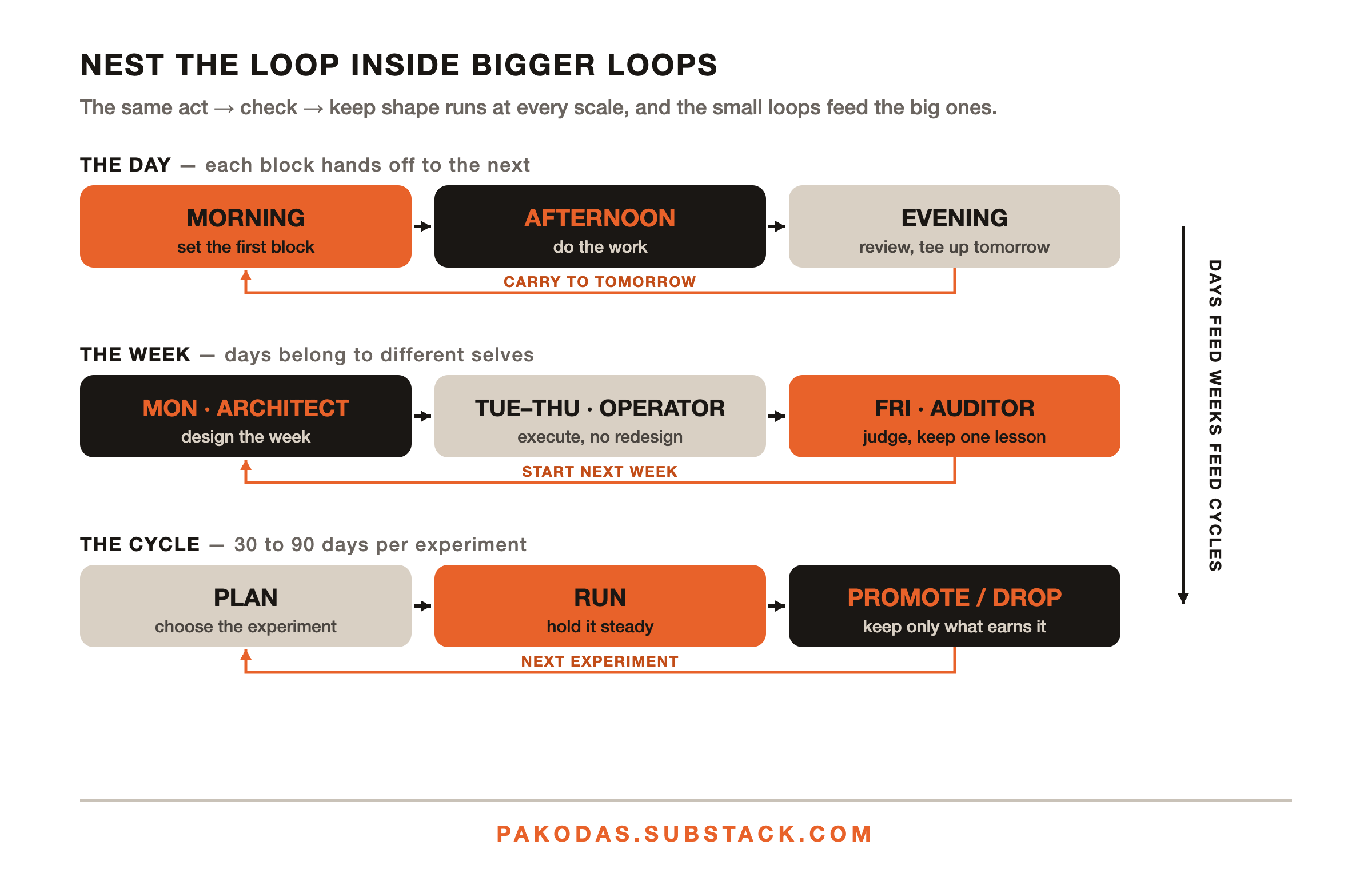
The shortest is the day. Morning sets up the afternoon, the afternoon does the work, and the evening reads how it went and lays out tomorrow’s first block. Each part of the day hands something to the next, which is why a good evening review is really just tomorrow morning’s head start.
The week is the next loop out, and it’s long enough to give your three selves their own days. Monday belongs to the Architect: pick the focus and design the week’s one experiment. Tuesday through Thursday belong to the Operator: heads down, no redesigning. Friday belongs to the Auditor: look at what the week actually produced, keep one lesson, and hand it forward.
The longest loop is the improvement cycle, thirty to ninety days per experiment, where you find out whether a change is worth keeping for good or was just a nice week.
The trick is that the small loops feed the big ones. A day’s evidence rolls up into the week’s verdict, and a run of weeks rolls up into whether the cycle’s experiment survives. Get the day loop honest and the ones above it mostly take care of themselves.
Don’t optimize the life out of your life
Personal RSI has a few predictable ways of going wrong. You can drive up hours worked while real progress slides. You can tune your whole routine to one freakishly quiet week. You can collect more data than you’ll ever read. You can turn rest into another contest. You can get so good at deleting bad days that spontaneity goes out with them.
If a protocol keeps eroding your curiosity, your autonomy, your sense of mastery, your enjoyment, your reason for doing any of it, that’s a regression, and no other number gets to overrule it.
So hold two questions at once. The first is about measurement: what would a carefully measured protocol recommend? The second is about flow: does this protocol protect the conditions my best work comes from?
A good system needs both. The best protocol doesn’t demand obedience to an ever-growing rulebook. It strips out the low-value decisions, ties today’s work to something you actually care about, guards your attention, leaves room to recover, and hands the next version of you better defaults than you started with. That’s what RSI can offer a life.
LinkedIn / @ptkbhv / GitHub / Books
Measure and optimise your AI productivity → Token Meter